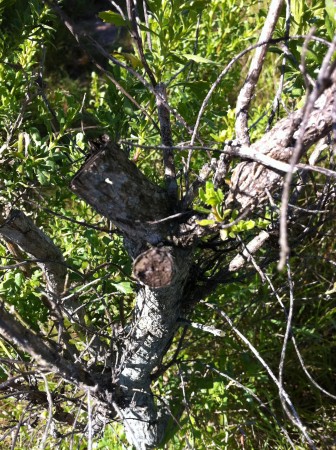
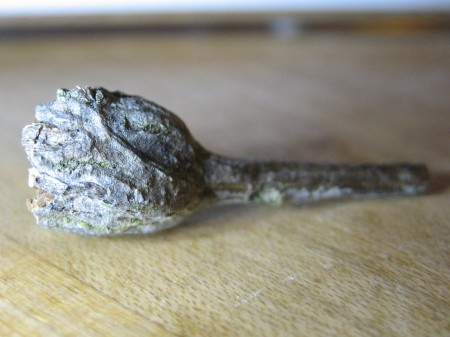
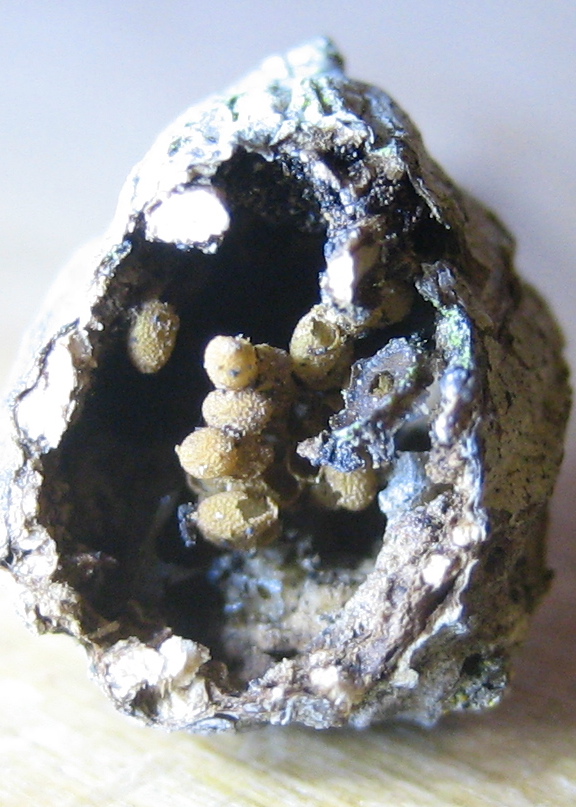
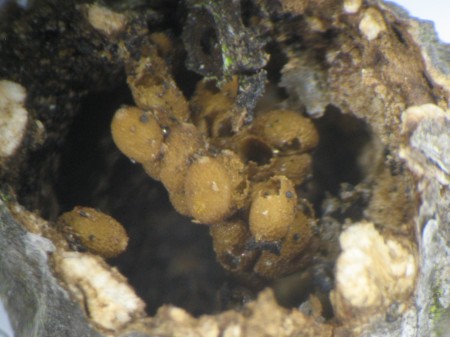
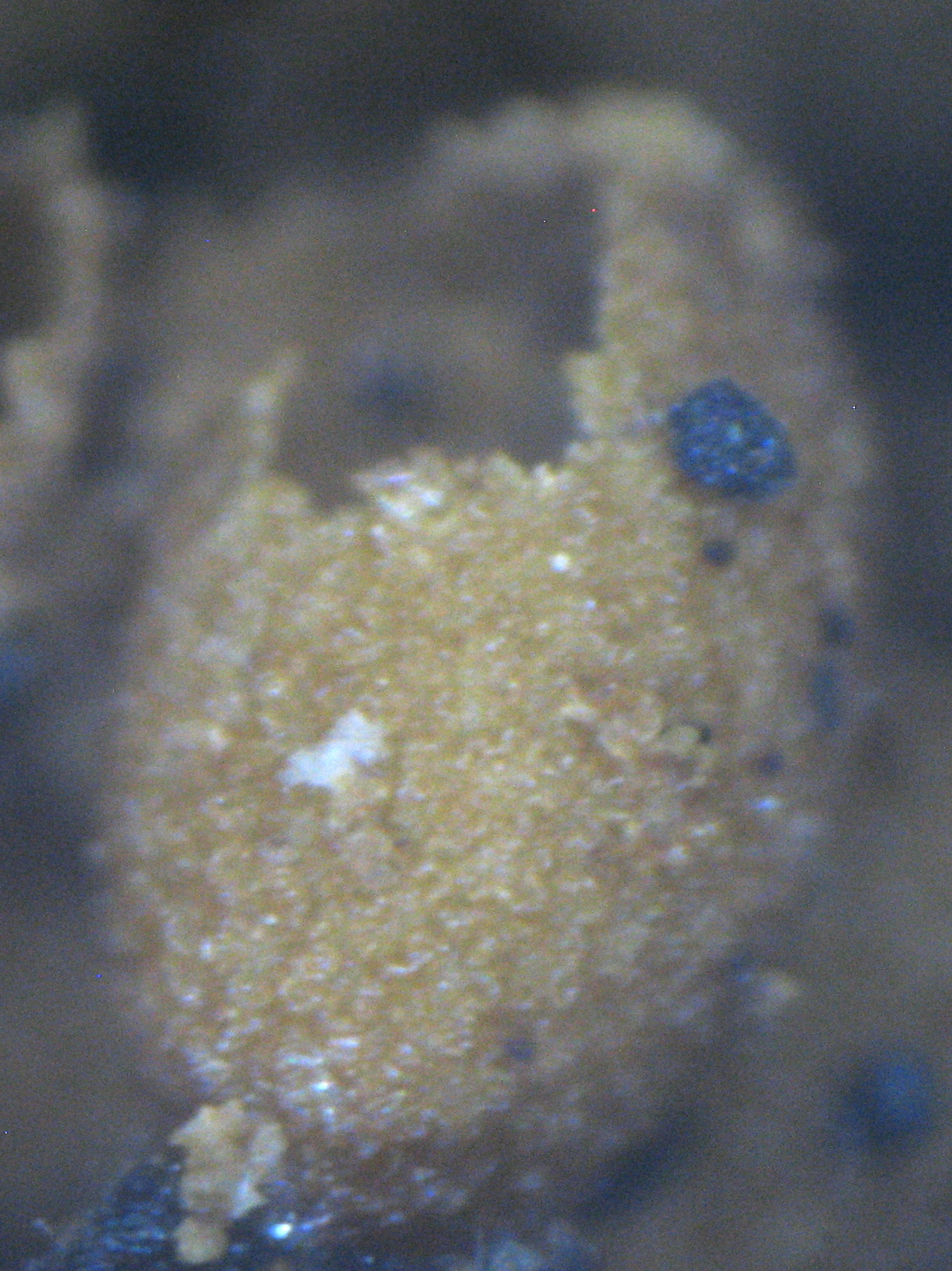
Back in January William and I took a walk at the Carpinteria bluffs, and saw that one of the big eucalyptus trees (Bluegum Eucalyptus, Eucalyptus globolus) along the Artists’ Passage had blown down in the wind. It was the easternmost tree, right where the path from the Bailard Avenue parking reaches the trees. The fallen tree was still there when I visited the bluffs today, and it actually seems to be doing okay for now; it’s at a steep angle, but the root ball seems to be more or less intact. I’m not sure if the city plans to do anything about it; I’ll have to ask Matt Roberts about that the next time I see him.
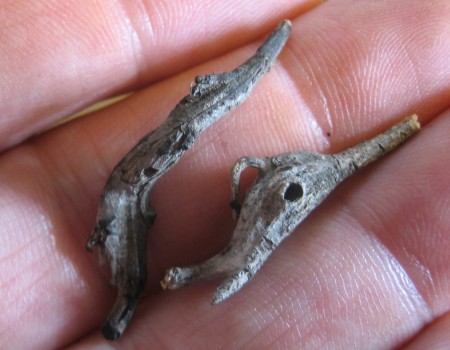
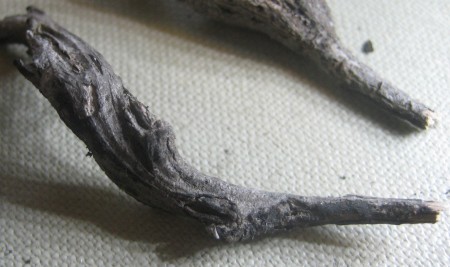
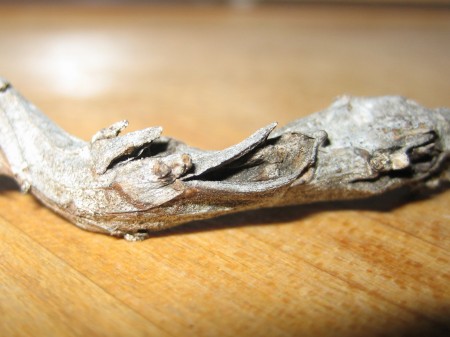
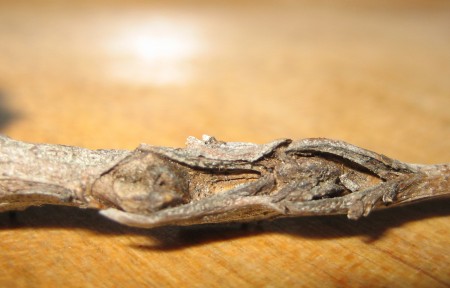
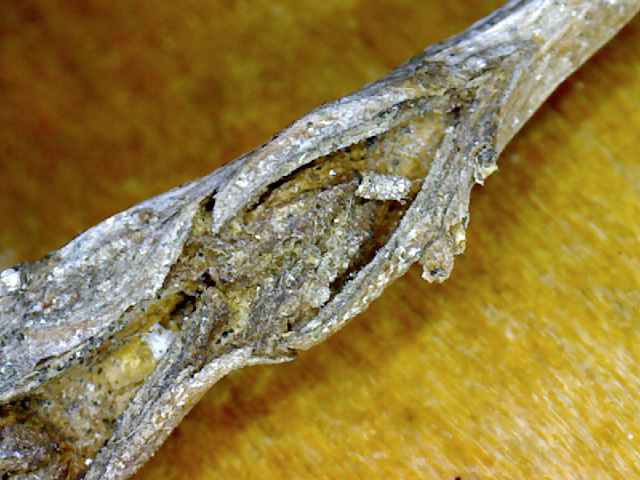
Toward the other end of the Artists’ Passage I noticed these interesting patterns in a fallen limb that had lost its bark:
I posted my photos to Bugguide.net, and Charley Eiseman (who else?) chimed in with some helpful pointers. The current consensus at Bugguide is that these galleries were made by the larvae of a species of cerambycid bark beetle, specifically, Phoracantha semipunctata, the Eucalyptus Longhorned Borer. That area in the upper picture where a bunch of small galleries diverge is where the beetle’s eggs were laid. As the larvae eat their way through the tree’s cambium layer they, and the galleries they make, grow larger, until you get the really wide galleries like the one in the lower photo. Eventually each larva eats a hole into the wood and pupates in it, before emerging as an adult beetle to repeat the cycle. I think that’s probably a pupation hole in the lower photo.
Like the trees they evolved to feed on, the Longhorned Borer is Australian. The Bluegum Eucalyptus trees were first brought to California from southern Queensland and Tasmania in the mid-1800s, and planted along the Southern Pacific Railroad lines as a source of lumber for railroad ties. According to Wikipedia, the railroad line that runs along the Artists’ Passage was completed in 1904, which I’m guessing is probably about the same time this row of trees was planted.
The beetles arrived in California in the 1980s, and have apparently become something of a pest. The galleries they leave behind are certainly interesting to look at, though.
Like the trees and the beetles, I’m not a native Carpinterian. I didn’t arrive here until 1995.
Last Saturday I was able to bird the “middle” portion of the Carpinteria salt marsh (normally inaccessible to outside visitors). Even better, I got to go in with Peter Gaede and Andrea Adams-Morden, two of my favorite people when I want to learn more about birds or plants (respectively). That’s damning with faint praise, though, in that Peter and Andrea are just fun to be with. They’re interested in everything going on in the natural world, always noticing things and always happy to share what they’ve noticed.
We entered on Estero Way, and worked our way out to the mouth of the marsh. Then we retraced our steps, and wrapped around next to the railroad tracks until we could walk out along the dike on the west side of the Santa Monica Creek channel. Toward the southern end of the dike there is a large patch of an invasive non-native with tall spindly stalks; Andrea tentatively ID’d it as black mustard (Brassica nigra). Here’s a shot looking past one of those stalks back toward the northwest:
I took that photo because Andrea had notice something interesting in the plant. Here’s a closer view:
It’s a collection of six spherical objects suspended in a loose web; Andrea’s guess was that they were spider egg sacs. Here’s a close-up:
There was one more interesting thing we noticed: Where the stem holding the spheres met the main stalk of the plant, there was a triangular structure that appeared to be made from the same silk as the web. You can see it on the left side of this picture:
Here’s a close-up:
We couldn’t find any spider to go with the putative egg cases, but after I got home I posted photos on bugguide.net, and within 15 minutes Charley Eiseman, co-author of the upcoming book Tracks & Sign of Insects & Other Invertebrates (which I can’t wait to buy) had ID’d the spheres for me. They are indeed the egg cases of a spider, specifically the Bolas spider Mastophora cornigera.
The spider is nocturnal; it hides in plain site during the day by looking exactly like a rounded bird dropping. (When I mentioned that to Andrea, she replied that she actually had noticed what she thought was a bird dropping on the plant not far from the egg sacs. I didn’t notice it at the time, and I can’t find it in any of my photos, unfortunately.)
The spider also has an interesting way of hunting: It dangles a strand of silk with a sticky ball on the end, and swings it with one of its legs to capture flying insects. The ball gives off a scent that mimics moth pheromones, and researchers have found that the spider can vary the scent over the course of an evening to appeal to different moth species that are active at different times of night.
Here’s a segment from David Attenborough’s Life in the Undergrowth showing M. cornigera hunting:
One mystery I still haven’t solved: What was that triangular silk structure at the base of the stem? I tried sending an email to Peter Bryant, a biologist at UC Irvine who has posted some neat photos of Bolas spiders on the web. I wrote him as follows:
I came across what I believe are some Mastophora cornigera egg cases yesterday at the Carpinteria Salt Marsh. I’m curious about one thing, though: There was an odd triangular structure, apparently built out of spider silk, at the point where the stem from which the egg sacs are suspended meets the main stalk of the plant. You can view a photo of the structure in relation to the egg sacs here:
At first I was thinking the structure might be a hiding place for the spider, but now that I’ve had some help identifying the species, and have looked at the wonderful photos you’ve posted of the adult female, I don’t think that structure would be large enough to hide one (and it doesn’t sound like they go in for that sort of thing, anyway, given their impressive bird-dropping mimicry).
I’m trying to figure out what purpose that structure might have. My lay speculation so far consists of:
* The aforementioned hiding place for the adult spider.
* A structural reinforcement, to prevent the weight of the egg sacs from causing the stem to break off the plant.
* A barrier to help prevent egg-sac predators from traveling from the stalk to the stem.
I’m curious if you know the answer, or would be willing to speculate. Thanks!
Dr. Bryant wrote me back, but unfortunately he didn’t have any ideas about that triangular silk structure. He suggested visiting the location again to see if the spider is nearby, which I’d love to do, but so far I haven’t had a chance (and I’d need to go with Peter, or someone else with official permission to enter that part of the marsh).
I’ve heard male crickets singing at night since I was a young boy, but I’ve never seen one singing. A few weeks ago Linda and I started hearing one in the backyard, and one evening I was interested enough to head out with a flashlight. I didn’t expect I’d actually be able to find the cricket; I’d always believed (without ever testing it) that crickets are natural ventriloquists, very hard to locate by ear, and that the insect would stop singing as I approached.
But no, it turns out this cricket was quite happy to let me locate and sneak up on him, and continued singing even as I got close enough (too close, it turns out) to snap this photo:
I say “too close” because the image is a little out of focus, something I didn’t notice until I got inside and uploaded the image to my computer. But by then I couldn’t go back and try for a better-focused shot, because while taking the above image I accidentally jostled a branch, causing him to stop singing and lower his wings (which are in their raised, singing position in that shot above). Here’s an even-fuzzier shot I got after he lowered his wings:
I got in trouble with Linda for making the cricket stop singing, and she forbade me to bother it any more; she’s still mad about it two weeks later. So that’s the best I can do, image-wise.
It turns out, though, that there’s lots of information about tree crickets (which is what this guy was) online; so I’ve since learned that this was probably either a snowy tree cricket (Oecanthus fultoni), which is found all through the lower 48 states, or a Riley’s tree cricket (O. rileyi), found only in the western states.
To tell the difference, I could have examined the little black markings in the first two segments at the base of the insect’s antennae. Or I could have carefully measured the temperature, and the rate at which the insect was chirping; Riley’s chirps are somewhat slower for a given temperature, while snowy chirps are somewhat faster. Snowy chirps also are faster in western populations than eastern ones, possibly because that helps the insects distinguish themselves from Riley’s.
I love the Internet.
Lots more about tree crickets is available at http://www.oecanthinae.com/, which apparently is the product of an amateur tree cricket lover who got bit by the bug (so to speak) fairly hard.
Finally, here’s 7 seconds of video of a male snowy tree cricket singing, courtesy of YouTube user TreeCricketFan, who may be the same hard-bitten obsessive mentioned above, or a different one; I’m not sure:
I’ve noticed this bee several times over the past few years: gigantic (bumblebee-sized or bigger), a beautiful golden color all over, with a habit of hovering for minutes at a time, pausing a few seconds in one place, moving a few feet, hovering again, and repeating, in a circuit that causes it to cruise a limited area over and over. Every time I’ve seen it engaged in this “hover patrol” it has been near some flowers being visited by ordinary honeybees, but I’ve never seen the giant golden bee actually land. I might be reading too much into it, but I get the impression that the bee is aware of me; it seems to face me and check me out, then decides I’m uninteresting and moves on.
I’ve seen this bee in our front yard in Carp, and outside the office building where I work in Santa Monica. (I’ve mentioned my ridiculously long commute, right?) Last Sunday William and I watched one patrolling outside some condos on Sandyland Road, as we walked from the State Beach campground (where we spent the night Sunday night) to the marsh and back.
I asked William what he thought the bee was doing. What’s up with that ceaseless patrol? It has to have a reason, I argued. The bee wouldn’t devote all that energy to the behavior unless there was some point to it.
I’ve tried to google for information about the bee before, without success. Today I tried again, and hit the jackpot.
The bee is the Valley carpenter bee, Xylocopa varipuncta. I’m used to seeing the female patrolling the eaves of houses and other wooden structures, looking for good spots to make a nest hole, and I knew that big black bee was a carpenter bee, but I never realized that this big golden bee was the male of the same species. An article from the UC Davis Department of Entomology quotes entomologist Lynn Kimsey as follows:
Carpenter bees, measuring about an inch long, are the largest bees in California. Their eggs are the largest of all insect eggs. The Valley carpenter bee egg can be 15mm long.
The males are territorial, Kimsey said, and can be quite aggressive. They hover and lie in wait for passing females.
“Female carpenter bees sting, but the males don’t have that apparatus,” Kimsey said. “You can pick up the fuzzy males and they won’t sting you.”
User INaturalist at bugguide.net posted this great image of the bee:
INaturalist wrote:
These big chubby guys come out in the spring and fly around in the willows where Coyote Creek flows into the percolation ponds. In Sunnyvale I find them in the Baccharis at the WPC ponds. They have a very short flight season — a couple of weeks and they’re gone. The females are black and yellow. This one is a drone — presumably its only function is to mate, so what is it doing patrolling? Waiting for a receptive virgin queen to emerge?
I think INaturalist’s speculation is probably right: The bee is on the lookout for females, and is patrolling a territory he’s staked out that seems likely to attract them.
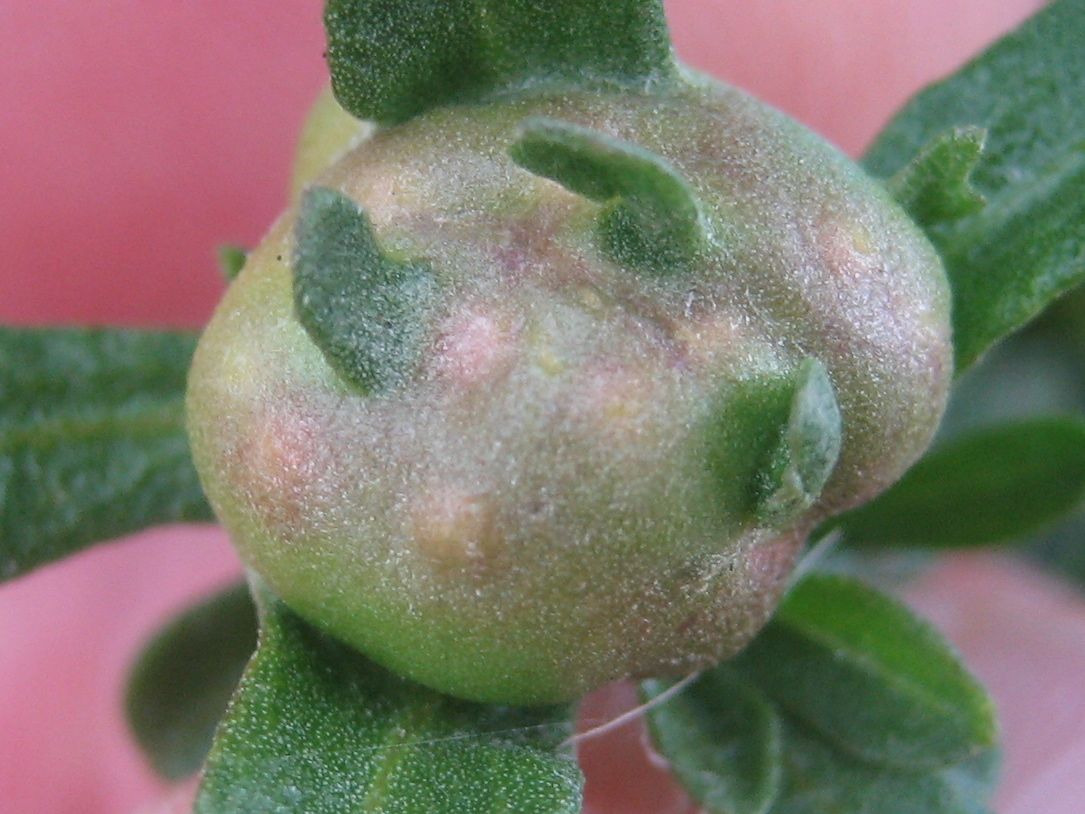
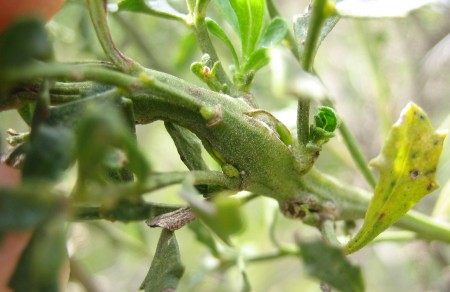
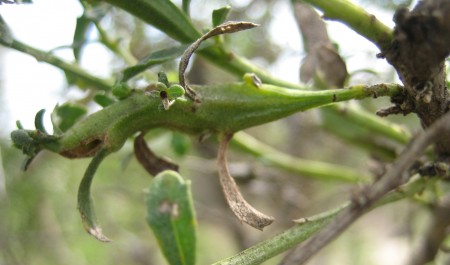
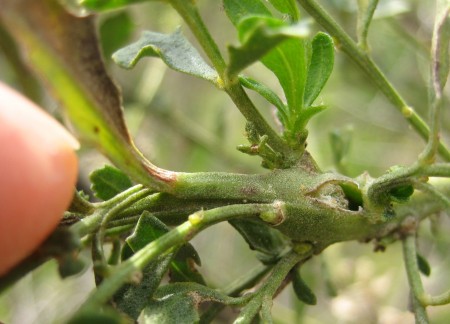
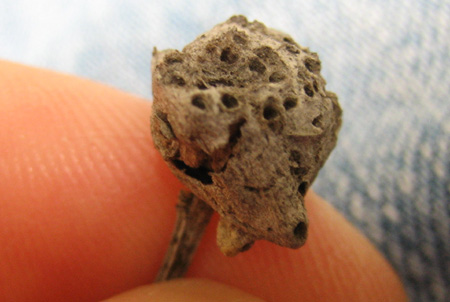
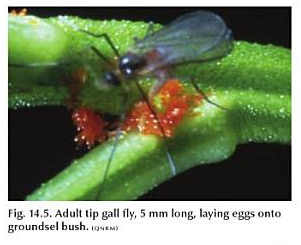
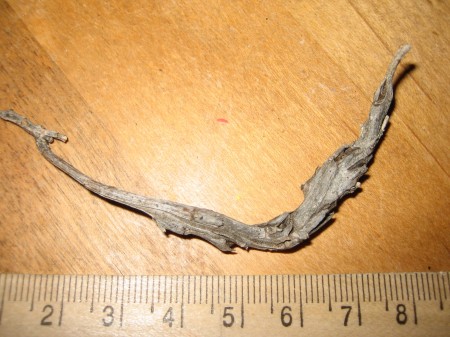
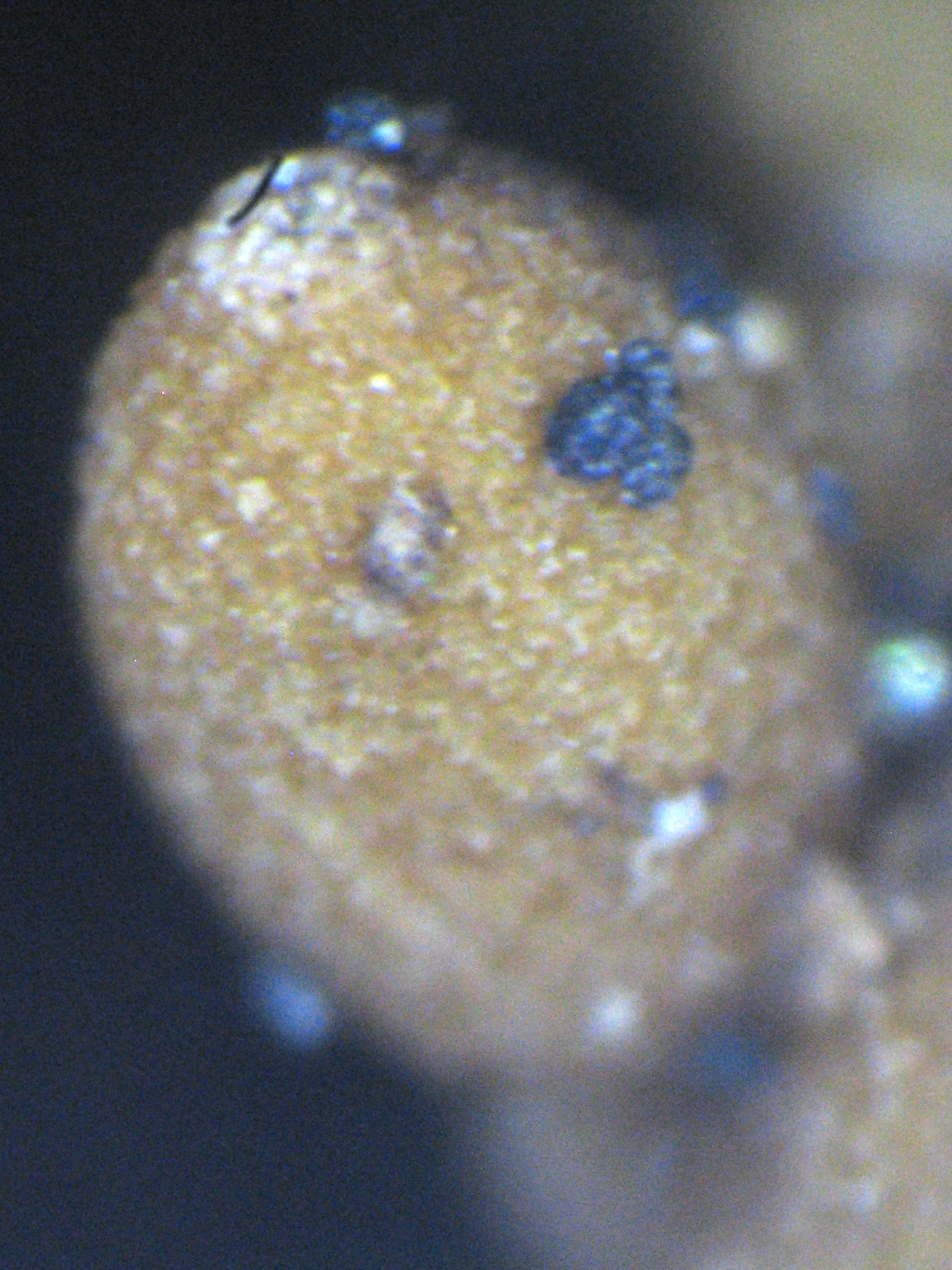
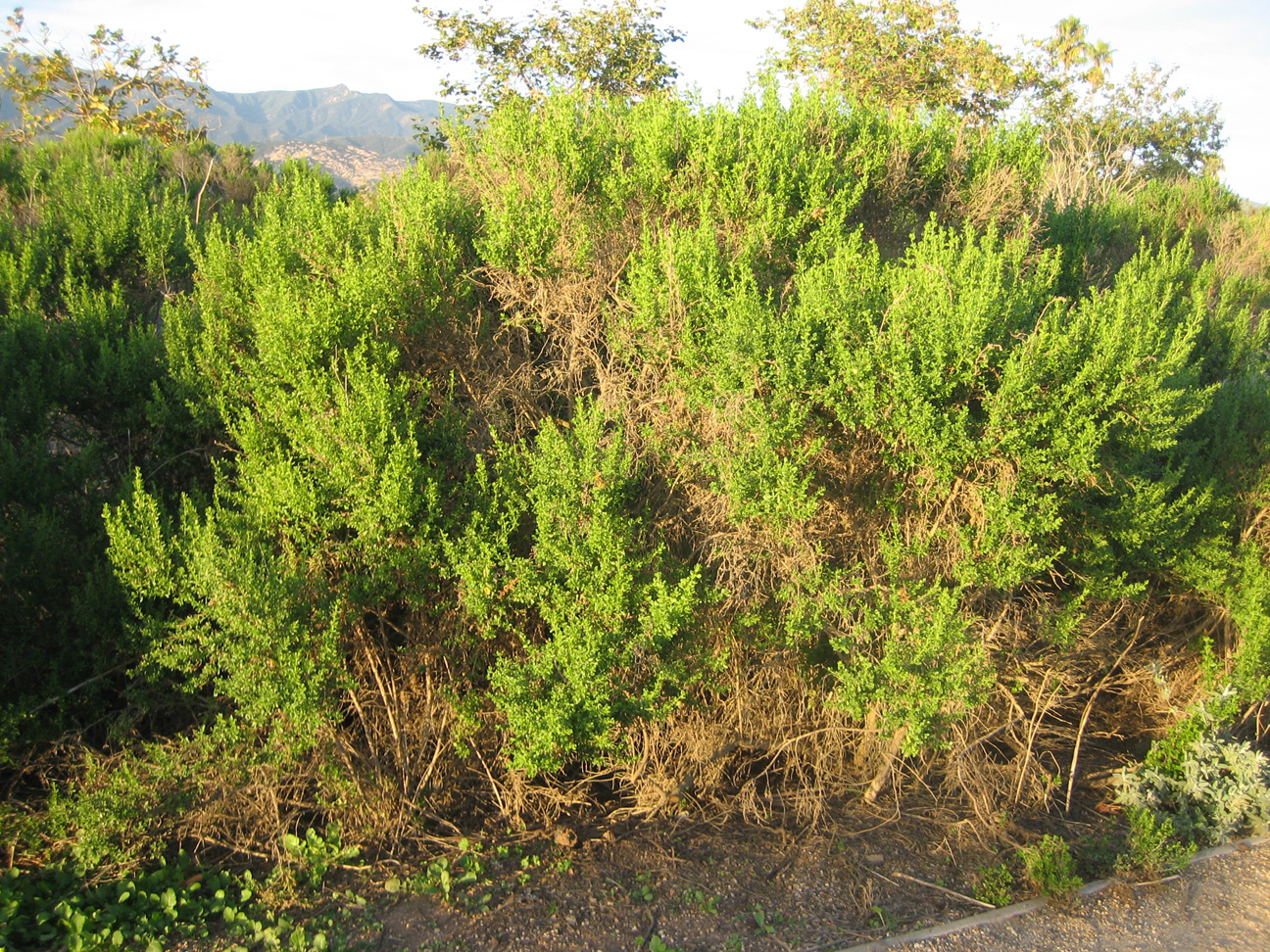
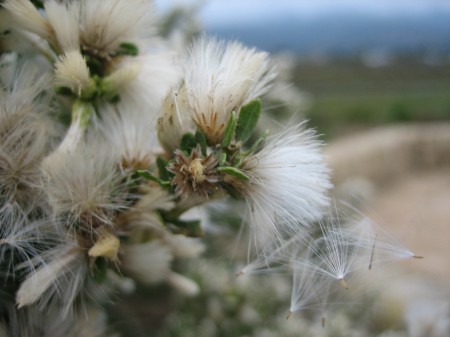
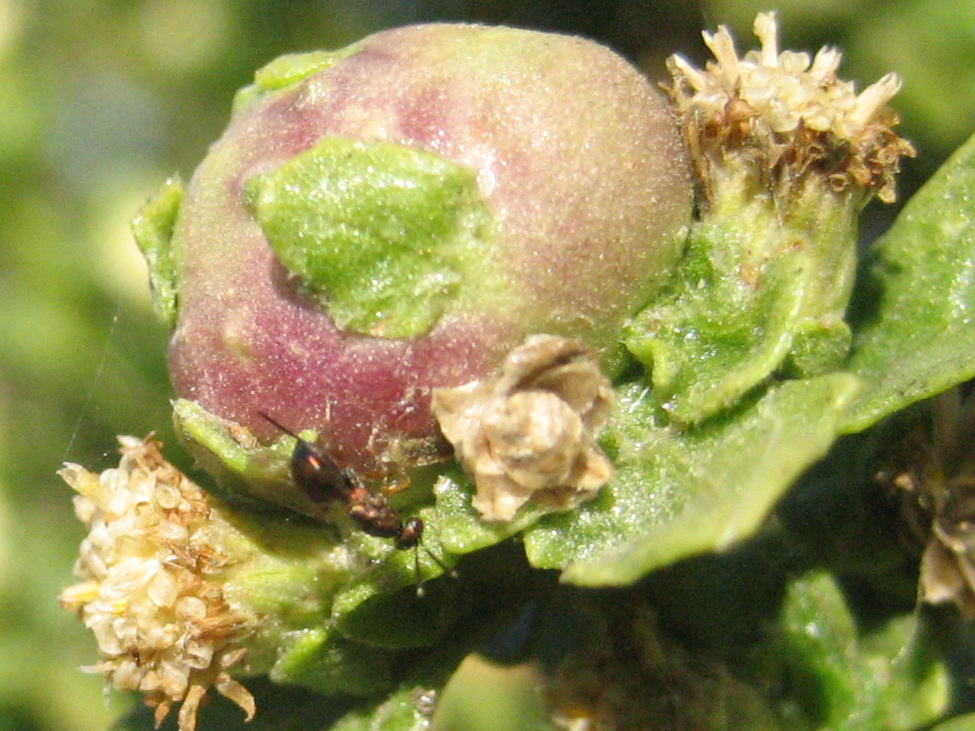
I headed to the marsh yesterday with William. My official goal was to examine the terminal bud galls on the coyote brush to see how many of them had emergence holes, and to see if I could find any adult Rhopalomyia californica midges hanging around.
The first thing we noticed at the marsh, though, was this tire near the northern Ash Avenue entrance. My guess is that someone just dumped it there, but maybe there’s more of a story behind it?
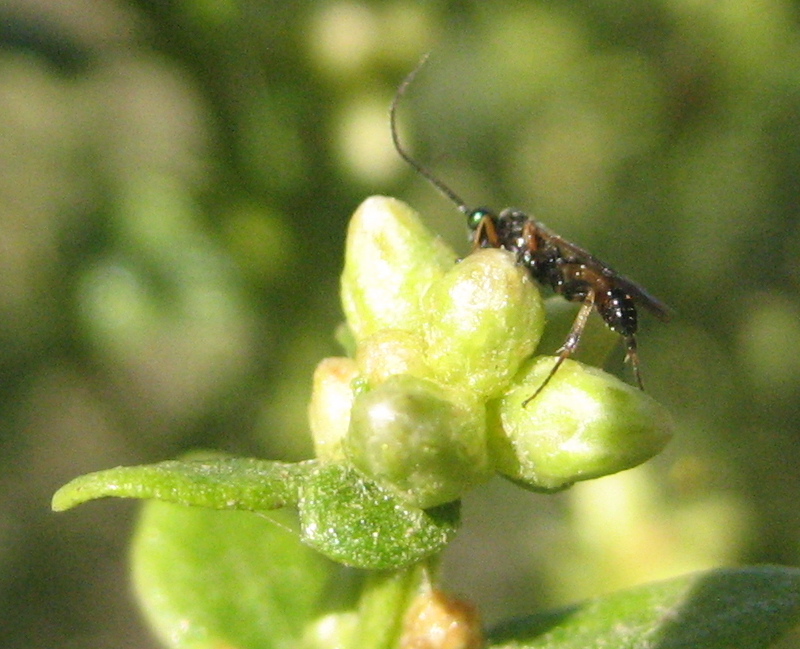
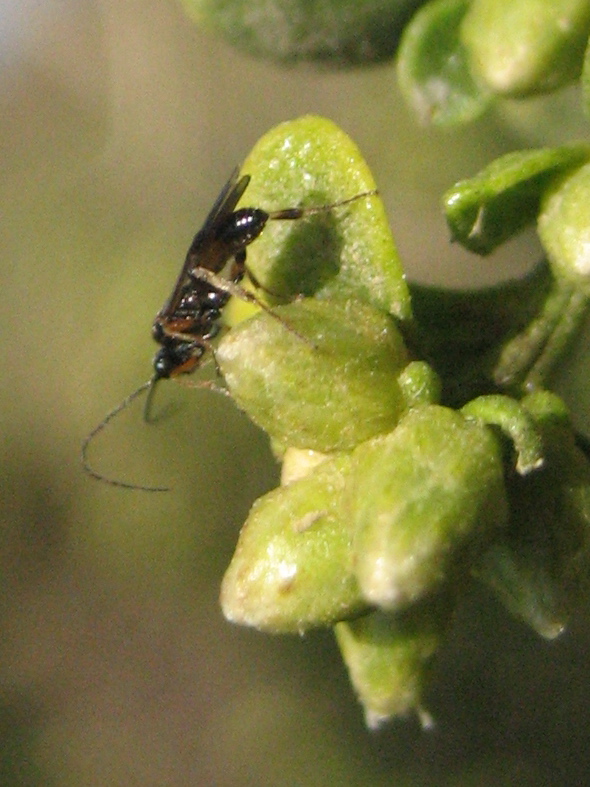
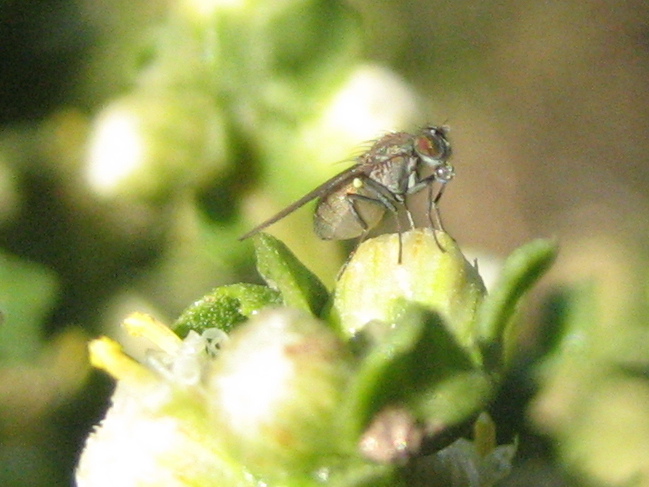
On the midge question, my (very rough) sense of things was that about half of the dozen or so galls I looked at had visible emergence holes. At one point while examining the terminal bud of a coyote brush (a bud that did not have a gall), I saw a small, black, winged insect climbing around, and I wondered if it might be a gall midge. It certainly looked fly-like, and was about the right size, judging by the emergence holes in the galls I’ve looked at. I tried to get a photo, but couldn’t get the focus right, and can’t see the insect in any of the shots I took.
Observational and experimental studies in the field demonstrate that this midge typically completes its entire lifetime reproduction in a single day: females usually emerge at dawn, mate, and after a posteclosion period of resting, they initiate a sustained period of active oviposition during which most eggs are laid over a 4–5-h period. Mean longevity of adult females is very short, consistently <1 d and only 5–6 h on clear and warm days.
I had no idea the adult midges were so short-lived: The females emerge as adults from the gall with their eggs fully formed, mate, deposit their eggs, and die, all within a single day. I guess that means I have my work cut out for me in terms of finding an adult gall fly.
As often happens when I visit the marsh, the thing I went looking for wasn’t the most interesting thing I found. Instead, my big discovery was how clear the water in the Franklin Creek channel was. You could see all the way to the bottom across the whole width of the channel, and William and I had great views of fish swimming under the footbridge.
Here’s a shot I took that shows five fish swimming in a line from the bottom of the frame toward the top. They were about 18 inches long; I think they might be striped mullet (Mugil cephalus):
Obviously, when I talk about how clear the water was, I’m talking in relative terms. Normally I can’t see the bottom at all, or see fish that are more than a few inches beneath the surface, so this view qualifies as exceptional in my book.
I also got several shots of what I think was a round stingray (Urolophus halleri). The ray was about the size of a dinner plate:
Here’s another shot I got just as the ray was swimming into my shadow. Unfortunately, I didn’t include the entire ray in the shot, but this gives a pretty good view of its coloration, including the big, pale spots on its body:
I’m not sure why the water in the creek was so clear yesterday. We had some light, unseasonal rain last week; maybe that brought some fresh, relatively clear water into the creek channel? In any event, it was really neat to get a good look at what was going on under the surface.