Archive for the ‘Carpinteria Salt Marsh’ Category

Bolas spider (Mastophora cornigera)

Saturday, December 12th, 2009

Last Saturday I was able to bird the “middle” portion of the Carpinteria salt marsh (normally inaccessible to outside visitors). Even better, I got to go in with Peter Gaede and Andrea Adams-Morden, two of my favorite people when I want to learn more about birds or plants (respectively). That’s damning with faint praise, though, in that Peter and Andrea are just fun to be with. They’re interested in everything going on in the natural world, always noticing things and always happy to share what they’ve noticed.

We entered on Estero Way, and worked our way out to the mouth of the marsh. Then we retraced our steps, and wrapped around next to the railroad tracks until we could walk out along the dike on the west side of the Santa Monica Creek channel. Toward the southern end of the dike there is a large patch of an invasive non-native with tall spindly stalks; Andrea tentatively ID’d it as black mustard (Brassica nigra). Here’s a shot looking past one of those stalks back toward the northwest:

IMG_1178

I took that photo because Andrea had notice something interesting in the plant. Here’s a closer view:

IMG_1175

It’s a collection of six spherical objects suspended in a loose web; Andrea’s guess was that they were spider egg sacs. Here’s a close-up:

IMG_1176

There was one more interesting thing we noticed: Where the stem holding the spheres met the main stalk of the plant, there was a triangular structure that appeared to be made from the same silk as the web. You can see it on the left side of this picture:

IMG_1174

Here’s a close-up:

IMG_1173

We couldn’t find any spider to go with the putative egg cases, but after I got home I posted photos on bugguide.net, and within 15 minutes Charley Eiseman, co-author of the upcoming book Tracks & Sign of Insects & Other Invertebrates (which I can’t wait to buy) had ID’d the spheres for me. They are indeed the egg cases of a spider, specifically the Bolas spider Mastophora cornigera.

The spider is nocturnal; it hides in plain site during the day by looking exactly like a rounded bird dropping. (When I mentioned that to Andrea, she replied that she actually had noticed what she thought was a bird dropping on the plant not far from the egg sacs. I didn’t notice it at the time, and I can’t find it in any of my photos, unfortunately.)

The spider also has an interesting way of hunting: It dangles a strand of silk with a sticky ball on the end, and swings it with one of its legs to capture flying insects. The ball gives off a scent that mimics moth pheromones, and researchers have found that the spider can vary the scent over the course of an evening to appeal to different moth species that are active at different times of night.

Here’s a segment from David Attenborough’s Life in the Undergrowth showing M. cornigera hunting:

One mystery I still haven’t solved: What was that triangular silk structure at the base of the stem? I tried sending an email to Peter Bryant, a biologist at UC Irvine who has posted some neat photos of Bolas spiders on the web. I wrote him as follows:

I came across what I believe are some Mastophora cornigera egg cases yesterday at the Carpinteria Salt Marsh. I’m curious about one thing, though: There was an odd triangular structure, apparently built out of spider silk, at the point where the stem from which the egg sacs are suspended meets the main stalk of the plant. You can view a photo of the structure in relation to the egg sacs here:

http://bugguide.net/node/view/356752/bgimage

…and a closeup of the triangular structure here:

http://bugguide.net/node/view/356754/bgimage

At first I was thinking the structure might be a hiding place for the spider, but now that I’ve had some help identifying the species, and have looked at the wonderful photos you’ve posted of the adult female, I don’t think that structure would be large enough to hide one (and it doesn’t sound like they go in for that sort of thing, anyway, given their impressive bird-dropping mimicry).

I’m trying to figure out what purpose that structure might have. My lay speculation so far consists of:

* The aforementioned hiding place for the adult spider.
* A structural reinforcement, to prevent the weight of the egg sacs from causing the stem to break off the plant.
* A barrier to help prevent egg-sac predators from traveling from the stalk to the stem.

I’m curious if you know the answer, or would be willing to speculate. Thanks!

Dr. Bryant wrote me back, but unfortunately he didn’t have any ideas about that triangular silk structure. He suggested visiting the location again to see if the spider is nearby, which I’d love to do, but so far I haven’t had a chance (and I’d need to go with Peter, or someone else with official permission to enter that part of the marsh).

More Bolas spider links:

Marsh Mallows

Saturday, October 3rd, 2009

mallows_closeup

The chaparral mallows (Malacothamnus fasciculatus) were really in bloom at the salt marsh a month or so ago, when I snapped this photo of a particularly attractive set of flowers. There still are a few mallow flowers here and there at the marsh, but lately it’s the coyote brush (Baccharis pilularis) that has been catching my eye. I think it’s interesting how there are male and female coyote brush plants, with each gender having its own, specific kind of flower. I’ll try to get some photos of those the next time I’m at the bluffs or the marsh.

High Tide

Thursday, July 23rd, 2009

high_tide_1_linear

Linda was the one who taught me to pay attention to the tide. Low tide is her favorite time to check out the rocks at Tar Pits, or walk the beach to the marsh entrance at Sand Point. If the tide is high, she’s not really interested.

But high tide is a great time to visit the marsh. I took a walk there last weekend, and timed it to coincide with maximum high tide. It was a 6.3; that is, the water’s surface was 6.3 feet above Mean Lower Low Water (MLLW). A 6.3 isn’t as high as it gets; at new moon a couple of days later (a couple of days ago, now, as I write this), the tide got up to 7.2.

At 7.2 pretty much all the low marsh habitat, which is dominated by pickleweed (Salicornia virginica), is underwater. Here’s a shot I got last weekend of some pickleweed taking its saltwater bath:

high_tide_salicornia

It’s a neat trick for a plant: being able to live in the open air, while also being able to survive immersed in seawater for hours at a time. The high marsh plants, like saltbush, ragweed, mugwort, and sagebrush, can handle a lot, but immerse them in salt water and they’re history.

Because of the tide, the marsh’s plant communities are vertically stratified, and once you learn to look for it it’s really obvious. Going from lowest to highest, the marsh’s major communities are:

  • Eelgrass beds – Below the lowest of low tides, in the bottoms of the channels that wind through the marsh, is eelgrass. These are strictly aquatic plants.
  • Mud flats – A little higher, in the intertidal zone, are the mud flats. Not much in the way of visible vegetation lives here, but there’s lots of decaying detritus. There are also microorganisms that feed on it, and lots of invertebrates, and aquatic vertebrates (like fish) and terrestrial vertebrates (like shorebirds) that take turns exploiting the flats as the water rises and falls.
  • Low marsh – This is the area where the pickleweed reigns supreme. Most of the time this community is above the waterline, but twice a day the high tide soaks its lower reaches, and twice a month (at the time of new and full moon) the high tide goes all the way to the top, killing any would-be invaders from the high marsh, and maintaining the boundary, as level as if it were layed out by a surveyor, between the two communities.
  • High marsh – A wider assortment of plants, tolerant of the high salt levels in the marsh soil, but incapable of actually being immersed.

There’s something else that happens during the highest tides in the marsh: Aquatic predators (like fish) invade the inundated area, picking terrestrial insects off the pickleweed stems. I’d love to see that.

high_tide_sunset

Mute Swan Siblings?

Sunday, July 12th, 2009

We’ve been seeing some young mute swans at the salt marsh for a while now. I had read some mentions of a trio of immature mute swans that people were seeing up in Santa Barbara, and it was just a few days later that I saw two of them, also immatures, down in the Carp salt marsh. I assumed they were the same birds, and that the three of them have been hanging around in various combinations ever since.

Lately I’ve been seeing a single mute swan, now in the stunning all-white adult plumage, in either the Franklin Creek or Santa Monica Creek channels at the marsh. Whenever I’m there with William and we see the swan he insists on my snapping a photo with my phone, so I have this to share: a shot of William watching the swan in the Franklin Creek Channel last weekend:

wm_swan2

This past Friday I was visiting UCSB as part of the incoming-freshmen-and-parents orientation (because Julia will be starting there in the fall), and as we were walking around near the dorms (which I note are in a more beautiful setting than anywhere I’ve ever lived), we spotted two mute swans in the campus lagoon. Here’s the (slightly fuzzy) shot I took:

ucsb_swans

I wonder if these are the other two of that original trio of siblings.

Clarity

Monday, June 8th, 2009

I headed to the marsh yesterday with William. My official goal was to examine the terminal bud galls on the coyote brush to see how many of them had emergence holes, and to see if I could find any adult Rhopalomyia californica midges hanging around.

The first thing we noticed at the marsh, though, was this tire near the northern Ash Avenue entrance. My guess is that someone just dumped it there, but maybe there’s more of a story behind it?

marsh_tire

On the midge question, my (very rough) sense of things was that about half of the dozen or so galls I looked at had visible emergence holes. At one point while examining the terminal bud of a coyote brush (a bud that did not have a gall), I saw a small, black, winged insect climbing around, and I wondered if it might be a gall midge. It certainly looked fly-like, and was about the right size, judging by the emergence holes in the galls I’ve looked at. I tried to get a photo, but couldn’t get the focus right, and can’t see the insect in any of the shots I took.

A little more googling for information about the midge turned up an article from the Annals of the Entomological Society of America, titled Portrait of an Ephemeral Adult Stage: Egg Maturation, Oviposition, and Longevity of the Gall Midge Rhopalomyia californica (Diptera: Cecidomyiidae). Quoting from the abstract:

Observational and experimental studies in the field demonstrate that this midge typically completes its entire lifetime reproduction in a single day: females usually emerge at dawn, mate, and after a posteclosion period of resting, they initiate a sustained period of active oviposition during which most eggs are laid over a 4–5-h period. Mean longevity of adult females is very short, consistently <1 d and only 5–6 h on clear and warm days.

I had no idea the adult midges were so short-lived: The females emerge as adults from the gall with their eggs fully formed, mate, deposit their eggs, and die, all within a single day. I guess that means I have my work cut out for me in terms of finding an adult gall fly.

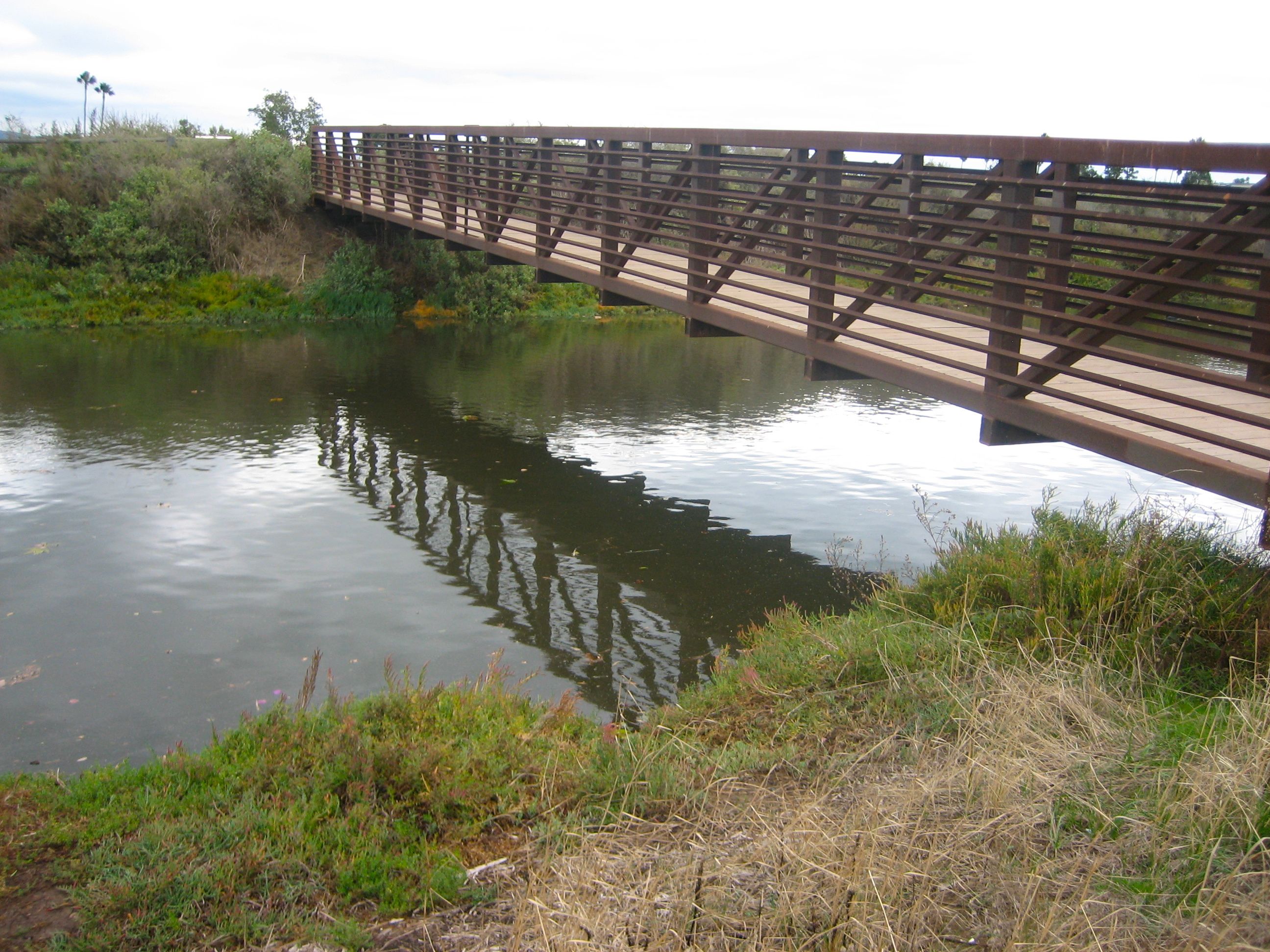
As often happens when I visit the marsh, the thing I went looking for wasn’t the most interesting thing I found. Instead, my big discovery was how clear the water in the Franklin Creek channel was. You could see all the way to the bottom across the whole width of the channel, and William and I had great views of fish swimming under the footbridge.

Here’s a shot I took that shows five fish swimming in a line from the bottom of the frame toward the top. They were about 18 inches long; I think they might be striped mullet (Mugil cephalus):

fish2

Obviously, when I talk about how clear the water was, I’m talking in relative terms. Normally I can’t see the bottom at all, or see fish that are more than a few inches beneath the surface, so this view qualifies as exceptional in my book.

I also got several shots of what I think was a round stingray (Urolophus halleri). The ray was about the size of a dinner plate:

ray2

Here’s another shot I got just as the ray was swimming into my shadow. Unfortunately, I didn’t include the entire ray in the shot, but this gives a pretty good view of its coloration, including the big, pale spots on its body:

ray1

I’m not sure why the water in the creek was so clear yesterday. We had some light, unseasonal rain last week; maybe that brought some fresh, relatively clear water into the creek channel? In any event, it was really neat to get a good look at what was going on under the surface.