Archive for the ‘Carpinteria Salt Marsh’ Category

Green Leaf Beetles

Tuesday, April 28th, 2009

Those beetle larvae I previously noticed all over the coyote brush at the marsh are now turning into adult beetles. Specifically, Trirhabda flavolimbata, a type of skeletonizing leaf beetle. Here’s a shot I got of one at the marsh last Saturday:

trirhabda_sm

I’ve also seen them at the Carpinteria bluffs. (Thanks to William in both cases for pointing them out. Even though I was specifically looking for them, it took my perceptive 11-year-old to actually find them.)

The number of adult beetles on the coyote brush is still pretty small; I saw a few bushes that had 4 or 5 beetles climbing around in one area, but if the vast number of larvae I was seeing in the marsh a month or so ago is any indication, we’re due for a lot more beetles to appear in the weeks ahead.

Santa Monica Creek: El Carro to the Salt Marsh

Sunday, April 26th, 2009

In my last post I took a walk along Santa Monica Creek north from El Carro Lane toward the mountains. This time I thought I’d take a walk in the other direction, from El Carro toward the salt marsh.

Near El Carro stands a tall sycamore, one of the last big trees along this part of the creek. Here’s a view looking up into its branches.

sycamore_sky

A little ways south of the sycamore, a footbridge crosses the creek. There are big bottlebrush bushes on each end of the bridge, with tons of bees (and Selasphorus hummingbirds). Here’s a shot looking north from “bottlebrush bridge”:

bottle_brush_north

Here’s a view looking south from the bridge toward Via Real:

bottlebrush_south

Down at Via Real, here’s the view looking back north:

via_real_north

Here’s the view looking south, across Via Real to the 101 freeway:

via_real_south

If you cross the freeway at Santa Ynez Avenue and head west along Carpinteria Avenue, you can rejoin the creek at the Carpinteria Avenue crossing. Here’s William looking north from there, with the 101 freeway in the distance:

carp_ave_north

Here’s the view looking south from a point along Sandyland Cove Road, toward the railroad crossing and the salt marsh:

sandyland_cove_road_south

Finally, here we are at the point where the concrete creek channel ends, looking back north past the railroad bridge toward the mountains:

mouth_north

Here’s the view from the end of the channelized creek looking south. Santa Monica Creek has now become a dredged channel through the salt marsh, winding toward the marsh entrance and the Pacific Ocean. That’s a young mute swan standing in the channel, just beyond a couple of American coots.

marsh_south

Marsh Invertebrates

Wednesday, April 1st, 2009

I really enjoy GrrlScientist’s Living the Scientific Life (Scientist, Interrupted) blog (especially the “Mystery Bird of the Day” feature), so when she mentioned recently that she was looking for submissions for the Circus of the Spineless blog carnival, I decided to take a walk at the salt marsh to look for invertebrates, and write about what I found.

There’s a new sign at the north entrance to the marsh, by the way. Wouldn’t this make a cool photo for Mystery Bird of the Day? Can you recognize the bird? It’s a common species in the marsh and on nearby beaches.

park_sign

One of the first invertebrates I noticed at the marsh during my walk were these shiny green insect larvae, happily munching away on the leaves of coyote brush (Baccharis pilularis).

caterpillars

These guys were on every coyote brush I looked at; I count six of them in this picture alone. I did a quick estimate, and decided that there were about 500 of them on a single large plant. Multiply that by the amount of coyote brush at the marsh, and that’s a lot of larvae.

At first I thought they were some kind of caterpillar, but after posting my photo at bugguide.net, early speculation has centered on the genus Trirhabda, a kind of leaf beetle. Looking at this image of Trirhabda flavolimbata made me remember that several months ago I’d seen a beetle that looked a lot like that all over the coyote brush. According to this entry at bugguide.net, there are at least three species of Trirhabda in coastal California, with T. flavolimbata being the one that specializes in coyote brush.

Update: I took most of the photos in this blog entry during a walk with William on Sunday, March 29. Based on the discussion at bugguide.net, I went back this morning — Thursday, April 2 — with Julia to get some better photos. Here are three that she took (posted at bugguide.net here, here, and here).

This gives you a good shot of the larva’s head:

green_larva_head

This shows the larva’s body, as well as a dark fluid on the plant that I’m assuming is related to the larva in some way, though I’m not sure how. Maybe it’s fluid that is draining from the fresh “frass” (insect poop) on the leaf above it?

green_larva_fluid

In reference to that fluid, Charley Eiseman, author of the upcoming book Invertebrate Tracks & Sign, wrote in response to an email I sent him:

If these were caterpillars or sawfly larvae, I might be a little worried about their health, but more “soupy” excrement isn’t too unusual for leaf beetle larvae.

You know, I never expected when I got out of bed this morning that I’d be learning about the consistency of leaf beetle excrement. But I think it’s cool that the larva’s soupy poop actually helps confirm the ID.

Finally, here’s a shot that shows the larva’s prolegs. Some of the commenters at bugguide.net were especially interested in seeing those.

green_larva_prolegs

[Back to the original blog entry.]

While looking at the coyote brush, I also noticed this interesting white object:

scale_insect_wide

I wasn’t sure at the time what it was, but I had a vague recollection that led me to google for “scale insect”, and sure enough, this looks a lot like a cottony cushion scale (Icerya purchasi) (and Charley Eiseman, writing at bugguide.net, agrees). Here’s a cropped version of the original image to give you a better look:

scale_insect

My google search led me to gardenbees.com’s Cottony Cushion Scale: The pest that launched a revolution in pest control methods. Among the things I learned there:

  • This is a female scale insect.
  • The actual insect is the brownish thing at the upper right, covered by white waxy fibers. She’s attached herself to the plant, and is more or less immobile.
  • The large, white, grooved part extending to the left is not her abdomen, as I originally thought. It’s an external egg case.
  • The cottony cushion scale is not native to North America. It hitchhiked here from Australia in 1868, arriving on a shipment of plants and soon becoming a serious pest in the California orange groves.
  • The scale was eventually controlled by introducing one of its natural predators, an Australian lady bug. When I read that, it reminded me that I’d already read another account of that same event, in Sue Hubbell’s excellent book, Broadsides from Other Orders.

Continuing the list of things feeding on the coyote brush, I noticed this swelling at the end of a coyote brush stem. It’s a gall, the work of an insect that lays its egg inside the plant, leading the plant to create an enlarged chamber within which the insect larva grows:

coyote_brush_gall

I had no idea what insect might have done this, though Charley Eiseman responded at bugguide.net that he thinks it was made by a species of midge, Rhopalomyia californica. Looking at some of the other photos at bugguide.net, I think he’s probably right. I’ve been unable to find an image of the adult midge, but Flickr user “Eric in SF” opened up one of the galls and took a photo of the larva.

According to an article abstract I found online (Ecology of Rhopalomyia californica Felt at Jasper Ridge), the midge “is under investigation as a possible biological control agent against related species of Baccharis that are rangeland weeds in Texas and Australia.”

Another type of gall can be seen in this photo. These are in a leaf of the arroyo willow (Salix lasiolepis) growing next to the boardwalk that winds through the marsh’s small patch of coastal dune habitat:

willow_gall

Again, I had no idea as to the species of insect involved, but Charley Eiseman wrote at bugguide.net that he thinks it is a sawfly of the genus Pontania.

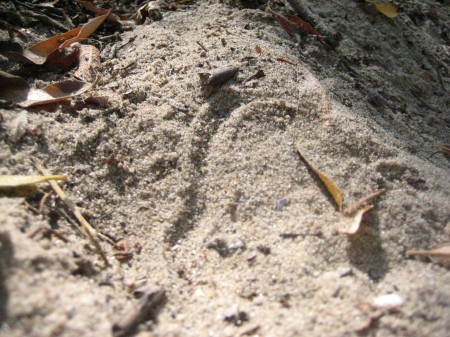
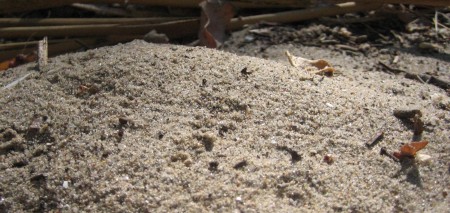
As I mentioned, the marsh’s patch of coastal dune habitat is small, but it’s very important to at least one species: the globose dune beetle (Coelus globosus), a coastal specialist that has become rare as coastal dunes give way to houses and condos. Andrea Adams-Morden has pointed out the trails in the dunes to me and told me they were produced by globose dune beetles, and I’ve seen a few dead beetles, but so far I’ve never found a live one. In the meantime, I like checking out their trails, which the beetles leave as they burrow just under the surface of the sand. Can you see the beetle trails in this photo?

beetle_tracks

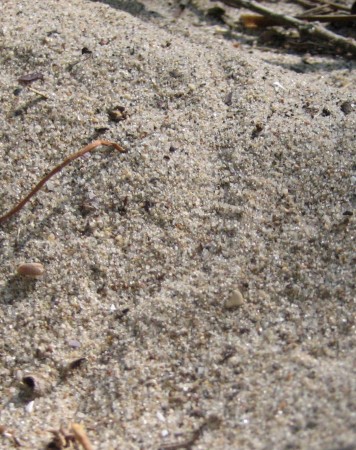
Here’s a closeup of some beetle trails. It looks to me like maybe there was a single beetle that entered from the upper right, did a counter-clockwise loop, crossed its own earlier trail, and exited at the upper left:

beetle_tracks_detail

There’s a neat series of photos of a related species, Eusattus dilatatus, at the myrmecos blog: Friday Beetle Blogging: Eusattus Dune Beetle. You can see the beetle burrowing into the sand, a process that takes about 30 seconds.

One of the best-known invertebrates in the Carpinteria salt marsh is the California horn snail (Cerithidea californica). Millions of these marine snails live in the marsh; you can see them crawling over the mudflats at low tide, and after they die their shells get washed out of the marsh entrance and turn up along the beach at Carpinteria, where I’ve picked up dozens of them during a single walk.

One of my favorite lectures during docent training was given by Dr. Kevin Lafferty, a parasitologist who has studied the use of horn snail parasites as a way of measuring ecosystem health in coastal marshes. I didn’t get any photos of horn snails during my walk in the marsh this past weekend, but I did take some photos of the very cool interpretive sign near the Franklin Creek bridge that talks about the complex life cycles of salt marsh parasites. Here’s a close-up of part of the sign:

horn_snail_sign_detail

If you want to learn more, you can see the image of the whole sign that I posted on Flickr, and click through to the largest size, which should be fairly readable.

One other invertebrate at the marsh, one that’s actually kind of similar to the California horn snail in size and shape, is the decollate snail (Rumina decollata). It’s a terrestrial snail, not an aquatic one. I noticed them crawling across the trail near Ash Avenue one morning when I was walking the marsh with William, and I was surprised, because I’d never seen an elongated snail like that on land before. An email to the carpmarshfriends Yahoo group got me some help with the ID, after which I learned more about the snail at the nice Wikipedia article on it.

Decollate snails are non-native; they originate near the Mediterranean, and are predators who feed on the eggs and young of other snails. They’re used by gardeners as a means of controlling another non-native, the invasive brown garden snail, and presumably that’s how these guys got into the marsh: crawling in from someone’s garden along Ash Avenue.

They’re nocturnal, and so far I’ve only seen them early in the morning after a rain. I couldn’t find any on my recent walk, but I did find this empty shell of one:

decollate_snail_shell

Update: When Julia and I returned to the marsh on April 2 to get better photos of the larvae on the coyote brush, we also found a decollate snail climbing in the blue-eyed grass (Sisyrinchium bellum). I really like this shot Julia took of it:

decollate_snail

She also got this shot from the other side, showing what looks to me like a thread of some sort emerging from the area of the snail’s mouth. I didn’t notice it at the time, so I can’t tell you anything else about it, but it’s certainly interesting. What’s going on with that?

decollate_snail_thread

Thinking about it some more, and staring at the largest version of the image, I find myself thinking a wacky thought: What if the snail actually ate a spider? Could that happen? If it did, could it have left the spider’s dragline extending away from the snail’s mouth? I guess it’s a lot more likely that the snail decided to snack on a stray piece of silk, or just ran into it and got tangled up.

Overall, I had a really fun time rummaging for invertebrates at the marsh. I hope you enjoyed reading about them.

Flower Time

Tuesday, March 31st, 2009

I’ve mentioned how I like to avoid driving on weekends, but I was happy to make an exception last Saturday when Linda suggested a trip to Figueroa Mountain. Here’s why:

figueroa_flowers

Those are lupines in the foreground, lupines and California poppies in the background, and people with dazed grins on their faces walking the trail. This was right by the road — I snapped the photo with my phone out the passenger window while Linda drove.

I’ve seen lots of interesting plant reproduction closer to home lately, too. The young California sycamores at the Heath Ranch Park had some pretty reddish fruits coming in the other day:

sycamore_fruit

It’s seeding time for the arroyo willows at the Carpinteria salt marsh; here’s a shot that shows seeds embedded in the fluff that will carry them away the next time a good wind blows through:

willow_seeds

Finally, I’d never noticed the blue-eyed grass at the marsh before; I’m not sure how I managed to just walk by such beautiful flowers in years past without paying attention. They were starting to fade when I was there today, but a few weeks ago they were really impressive looking:

blue_eyed_grass

Weeding the Land Trust Parcel at the Marsh

Thursday, January 22nd, 2009

When I heard last Sunday that then-president-elect Obama was calling for the Martin Luther King holiday to be a national day of service, I suddenly remembered an email that Pat Blakeslee had forwarded to the Carpinteria Salt Marsh friends list:

From: William Abbott
Sent: Wednesday, January 14, 2009 5:04 PM
Subject: Salt Marsh restoration party: Martin Luther King Jr. Day

Hello all Salt Marsh Friends,

We have good news for Martin Luther King Jr. Day! Patagonia and the Land Trust are facilitating a restoration work party, starting at 9AM on Monday. Patagonia is sending 6 volunteers from 9 to NOON; any local Salt Marsh lovers are welcome to join in and stay for as long as they like! Bring waders, if you have any!

By William Abbot’s count, 21 volunteers showed up for the event (counting me); here’s a shot he took of us doing our weeding (that’s me in the middle):

weed_day12

Here are some of us at the end of the event (again, that’s me in the middle):

weed_day22

The best part for me was that I got to pester Andrea Adams-Morden (second from the right in that second picture) with all manner of questions about the plants we were pulling up, and the ones we were putting in. Andrea is the volunteer coordinator for the marsh docents, and knows an awful lot about the plants in the marsh.

Monday’s event was in the part of the marsh that is owned by the Land Trust for Santa Barbara County. That’s the part beyond (that is, west of) the new footbridge spanning Franklin Creek. It’s interesting to compare it to the city-owned section near Ash Avenue, where a lot of restoration work was done in the late 1990s, and where volunteers have been doing monthly weeding sessions ever since. The Land Trust parcel is weedier (in the sense of having more non-native plants), and also has some bare spots where mud gets dumped during flood-control dredging. In both ecological and aesthetic terms it’s arguably more degraded than the area along Ash Avenue. On the other hand, it’s also farther away from day-to-day human activity. It’s quieter, and wilder. It’s the part of the marsh where the (non-native, I realize, but still very cool) red foxes hang out.

On one of my first trips across the footbridge after it was opened last summer, I sat on one of the big, rounded boulders near its western end. There’s a small channel there, with a pool where egrets and herons like to fish. I sat there for a while, enjoying the solitude, and then I noticed an odd sound. It was a sort of whispering, a very low-volume series of pops and clicks, coming from the muddy margin that the low tide had exposed. It took me a second to realize what it was: The sound of hundreds of horn snails crawling through the mud.

horn_snails

The Land Trust parcel at the marsh is a work in progress. But I really like it, and it felt good to be able to help it out with some weeding.